


Product: Abaqus/Standard
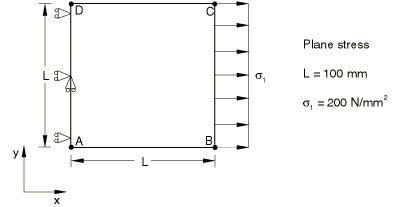
Material:
Young's modulus = 200 × 103 N/mm2, Poisson's ratio = 0.3, Creep law:  = A
= A
 A
A
 , A = 10–16, A = 10–14,
  = 5.0, and m = 0.5.
Boundary conditions:
 on line AD and
  at mid-point of line AD.
Loading:
Prescribed tensile stress  = 200 N/mm2 on line BC.
This is a test recommended by the National Agency for Finite Element Methods and Standards (U.K.): Test 12(a) from NAFEMS Publication Ref: R0027, “NAFEMS Fundamental Tests of Creep Behaviour,” June 1993.
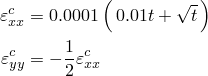
The results are shown in the following table. The values enclosed in parentheses are percentage differences with respect to the reference solution.
| Abaqus Results | ||
|---|---|---|
| t |  |  |
| 0.00 | 0.000 (0.00%) | 0.000 (0.00%) |
| 6.41 | 0.000222 (–14.35%) | –0.000111 (–14.35%) |
| 70.41 | 0.000845 (–7.09%) | –0.000423 (–7.09%) |
| 382.73 | 0.002260 (–3.78%) | –0.001130 (–3.78%) |
| 536.33 | 0.002770 (–2.87%) | –0.001385 (–2.87%) |
| 823.05 | 0.003606 (–2.32%) | –0.001803 (–2.32%) |
| 1000.00 | 0.00408 (–2.02%) | –0.002038 (–2.02%) |
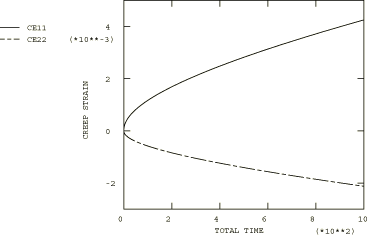
The total creep time for this test is 1000 hours. The times listed in the above table are the times calculated by the Abaqus automatic time stepping algorithm with CETOL = 1. × 10–5. The creep law is defined via user subroutine CREEP.